
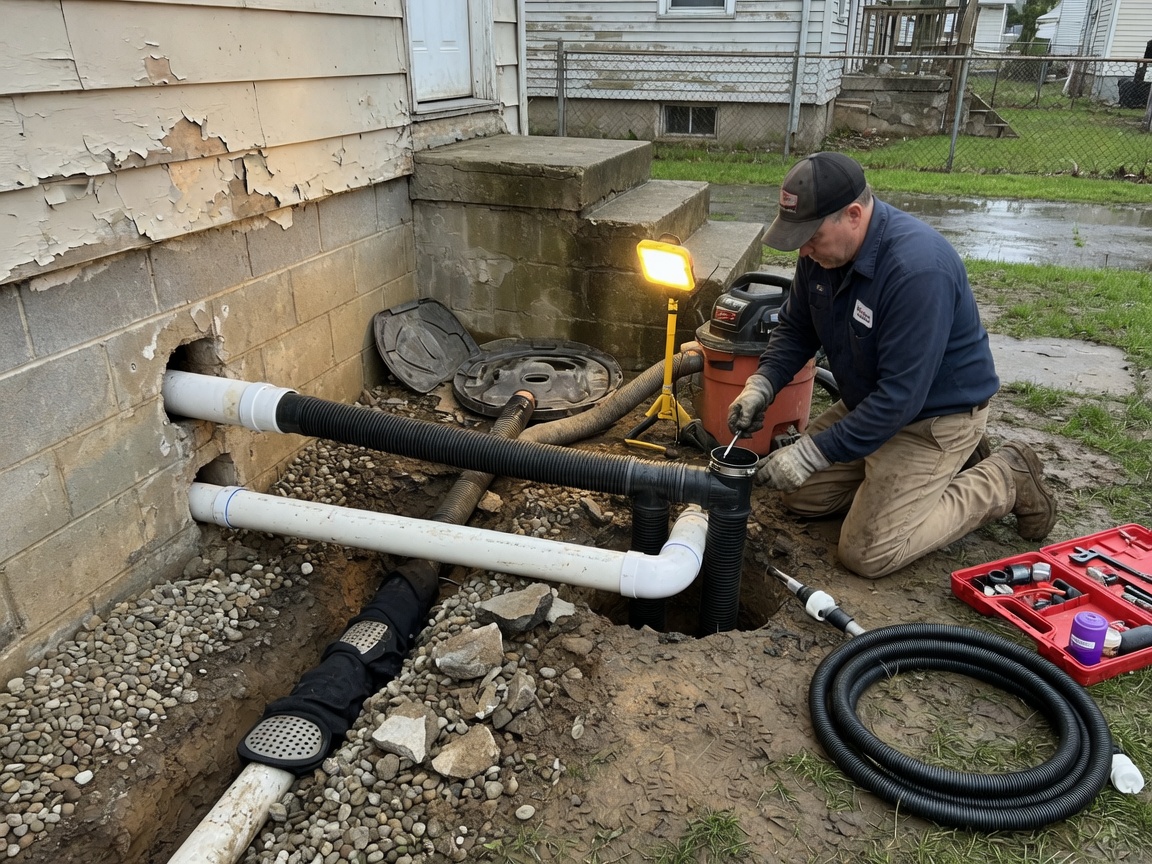
McDonald is a small village just west of Niles, built largely as housing for the steel industry in the first half of the twentieth century. That history shows up in the basements: compact lots, homes built close together, shallow basements in clay soil, and sump pits that were almost all cut in long after the houses went up. Pit size and placement are inconsistent as a result, and we check both before assuming a pump is at fault.
The tight lots create a discharge problem that is specific to places like McDonald. There is simply not much distance between one foundation and the next, so a discharge line has limited room to get water genuinely clear of the house — and an outlet that empties a few feet from the wall hands the pump the same water to move twice. It also raises a neighbor question, since water directed sideways on a narrow lot ends up on someone else's property. Getting discharge right here takes more thought than on an acre, and it is worth the thought, because it is the difference between a repair that holds and a basement that keeps getting wet.
Around McDonald
We regularly work near:
- 📍McDonald High School
- 📍Ohio Avenue
- 📍Mahoning River
- 📍McDonald Village Park
- 📍Route 46
Sump Pump Repair in McDonald — Local Notes
- •Compact village lots leave limited room to route discharge genuinely clear of the foundation.
- •Short discharge runs recirculate the same water back toward the footer.
- •Early twentieth-century steel-era housing with shallow basements in clay soil.
- •Retrofitted pits of inconsistent size and placement are the norm.